
What Is an AI Copilot? How Human + AI Can Elevate Customer Experience
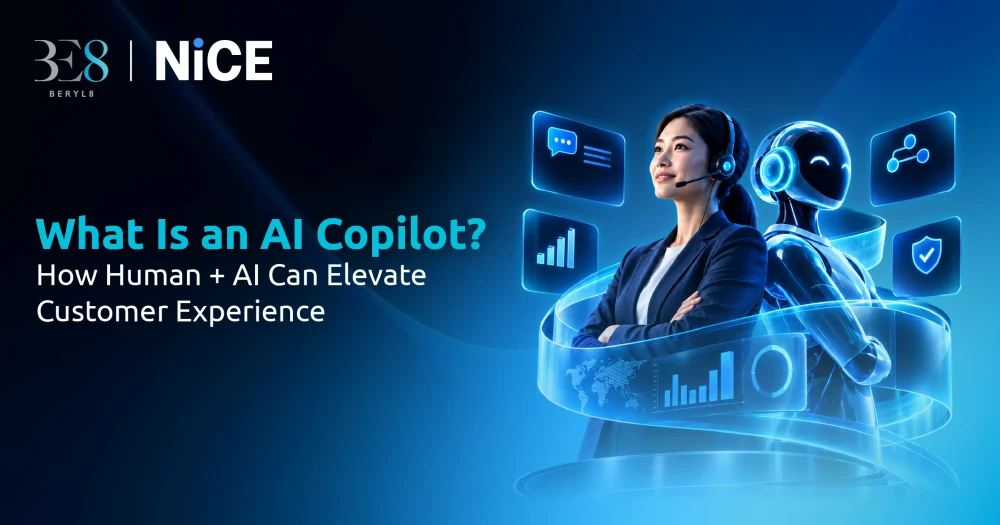
Bringing AI into customer service is not simply about increasing automation or replacing human agents. One of the most significant opportunities lies in augmenting the capabilities of service teams—helping agents work faster, access the right information, and respond to customers more effectively.
This is where AI Copilots are becoming increasingly relevant to modern contact centers.
Working alongside human agents in real time, an AI Copilot can analyze conversations, surface relevant information, recommend next-best actions, and automate tasks during and after customer interactions.
Instead of requiring agents to search across multiple systems, an AI Copilot can bring relevant context and intelligence directly into their workflow—enabling Human + AI to work together to deliver better customer experiences.
What Is an AI Copilot?
An AI Copilot is an AI-powered assistant designed to support human agents during live customer interactions. It works in the background to provide real-time information, recommendations, and automation while keeping the human agent in control of the conversation and critical decisions.
When connected to CRM platforms, knowledge bases, and enterprise systems, an AI Copilot can surface relevant customer information, reduce the need for agents to switch between multiple applications, summarize conversations, understand context, and support multilingual customer service.
The objective is therefore not to remove humans from the customer journey, but to give agents the intelligence and tools they need to serve customers more effectively.
How Does an AI Copilot Work?
Behind an AI Copilot is a combination of AI capabilities.
Natural Language Understanding (NLU) helps interpret customer intent and context. Conversational AI helps maintain the context of an interaction, while Generative AI can support response generation and summarization.
Combined with enterprise knowledge and data, these capabilities allow an AI Copilot to surface relevant information and recommend next-best actions based on the context of each interaction.
For example, when a customer contacts a service center with an issue, an agent may otherwise need to search across customer history, policies, and knowledge articles manually. An AI Copilot can help retrieve and present relevant information in real time.
This allows agents to spend more time understanding and resolving customer needs rather than searching for information.
AI Copilot vs. Chatbot vs. Autonomous AI Agent
Chatbots, AI Copilots, and Autonomous AI Agents can all support customer service, but they differ in their roles and levels of autonomy.
A chatbot typically handles relatively defined customer interactions, such as FAQs and basic service requests, with escalation to a human agent when necessary.
An AI Copilot follows a Human-in-the-Loop model. It supports human agents with information, recommendations, and automation while the agent remains responsible for customer interaction and key decisions.
An Autonomous AI Agent, meanwhile, operates with a greater degree of autonomy. It can interpret inputs, make decisions, and execute multi-step tasks without requiring a human agent to control every action.
The decision is therefore not about which technology is inherently better. Organizations need to determine the right approach based on the use case, level of complexity, and the role they want Human + AI to play.
How Can AI Copilots Elevate the Contact Center?
The value of an AI Copilot goes beyond the technology itself. What matters is the impact it can create for agents, operations, and customers.
1. Agent Productivity
AI Copilots can reduce manual work throughout the customer interaction—from searching for information and accessing knowledge to summarizing conversations and completing post-interaction tasks.
With less time spent on administrative work, agents can focus more on customer needs, complex problem-solving, and interactions where human expertise adds greater value.
2. Faster Resolution
Real-time access to customer context, enterprise knowledge, and relevant information can reduce the time agents spend searching for answers.
By providing the right information and recommendations at the right moment, an AI Copilot can help agents respond and resolve customer issues more quickly.
3. Better CX
When agents have immediate access to relevant context and intelligence, customer interactions can become faster, more consistent, and more personalized.
The benefits of an AI Copilot therefore extend beyond agent efficiency to the quality of the customer experience itself.
Moving from AI Technology to Business Outcomes
For enterprises, AI Copilot adoption should begin with the business outcomes they want to achieve—not with the technology alone.
Organizations may want to reduce average handling time, improve first contact resolution, reduce time spent searching for information, or enable new agents to become productive faster.
Defining these outcomes helps organizations identify the right use cases and establish clearer ways to measure the impact of AI.
In practice, AI Copilot can provide customer service representatives with real-time assistance, automate routine tasks, and help agents access relevant information more efficiently. These capabilities can translate into measurable improvements in productivity, service efficiency, and customer experience.
The value of AI Copilot should therefore not simply be measured by whether AI has been deployed, but by the outcomes it creates across operations, employees, and customer experience.
What Should Enterprises Prepare Before Scaling AI Copilot?
Moving AI Copilot from pilot to enterprise-wide adoption requires more than selecting the right technology.
Organizations should begin with use cases that can deliver clear business value, then assess the readiness of the data and knowledge that AI will need to access. Integration with CRM, contact center platforms, and other enterprise systems also needs to be considered.
At the same time, security, governance, and compliance should be addressed from the beginning—particularly when AI interacts with customer or enterprise data.
People and processes are equally important. Agents need to understand where AI can support their work, how to use AI-generated recommendations appropriately, and how feedback can be used to continuously monitor and improve AI performance.
The objective is not simply to deploy AI, but to integrate it into customer service operations in a way that can be adopted, governed, and scaled.
Human + AI: The Next Step for Customer Experience
AI Copilot represents an approach to contact center transformation that moves the conversation beyond “Human or AI?” toward a more important question: “How can Human + AI work together to create better outcomes?”
AI can take on repetitive tasks, analyze information, and bring intelligence to agents when they need it. Human agents continue to play an essential role in interactions that require empathy, judgment, and complex problem-solving.
When the two work effectively together, organizations can improve Agent Productivity, enable Faster Resolution, and deliver Better CX.
BE8 and NiCE Cognigy bring together their expertise to shape the next generation of Customer Experience with Human + AI, helping organizations connect AI with customer interactions, enterprise data, and workflows while aligning implementation with business use cases, existing systems, and organizational readiness.
You might also be interested in:

Happiness Starts at Work: How Employee Satisfaction Leads to Increased Efficiency at Work – and Outside of it

Workflow Automation with Electronic Signatures